Specific Weight Of Mercury In Kg M3. Engineering mechanical engineering q&a library the specific gravity of mercury is 13.6. We've got the study and writing resources you need for your assignments.
PPT Fluid Mechanics (CE201) PowerPoint Presentation from www.slideserve.com
S = 7856 / 1000. Pure water = 1) density of substance (ρ) 100% (2 ratings) transcribed image text:
Mass Per Unit Volume Of A Fluid Is Called Density.
Compute the density of water and the specific weight and density of mercury sol: The specific gravity of mercury is 13.56. The conversion formula used by this tool is:
Experts Are Tested By Chegg As Specialists In Their Subject Area.
Mercury weighs 13 534 kg/m³ (844.90002 lb/ft³), melting and boiling points, molecular formula and weight, molar volume, cas rn, description and reference The density of a metal tool is given as 7856 kg / m3. Γ = 1000 [kg/m 3] * 9.81 [m/s 2] = 9810 [n/m 3] = 9.81 [kn/m3] the density of water is 1.940 slugs/ft3 at 39 °f (4 °c).
82.2 Kn/M^3 > Problem Answer:
The specific weight of water at ordinary pressure and temperature is 9.81 kn/m3. The density will be displayed as a specific gravity ratio in the lower text box. A beam rests on a fulcrum, 1.2 m from one end.
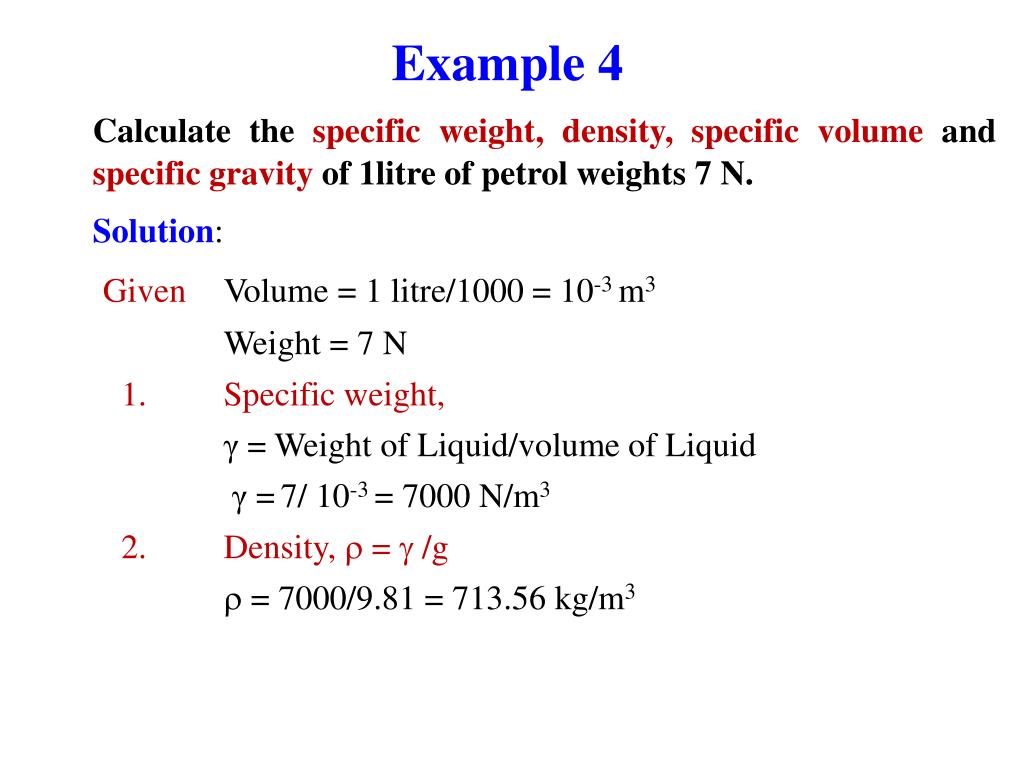
Γ = Ρ G [Kn/M3] Where, Ρ = Density [Kg/M 3 ] G = Standard Gravity [M/S 2] Standard Gravity, G Is The Acceleration Is Due To Gravity, Which Is Taken As 9.81 M/S 2 On Earth.
Density is defined as mass per unit volume. A large iceberg floating in sea water is of cubical shape and its specific gravity is 0.9 if Unit of mass and has units of (m3/kg or ft3/slug) specific gravity (s.g.) is defined as the ratio of the density of a substance to the density of water at specified temperature and pressure s.g.= fluid / water specific weight (γ) of any liquid can be calculated by γ=(s.g.)×γ water specific volume and specific gravity
For Example, The Density Of Water At 16 O C Is 999 Kg/M 3 While The Density Of Mercury At 20 O C Is 13,550 Kg/M 3.
The specific gravity of mercury is 13.6. What is the specific weight of mercury? It is commonly known as quicksilver and was formerly named hydrargyrum (/haɪˈdrɑːrdʒərəm/).