Two Complementary Non Adjacent Angles. Write the measure of the angle that is complementary to ðtuq. To fully understand complementary angles, you must keep in mind the following concepts that include some important characteristics and features:
PPT Angle Relationships Day 1 PowerPoint Presentation from www.slideserve.com
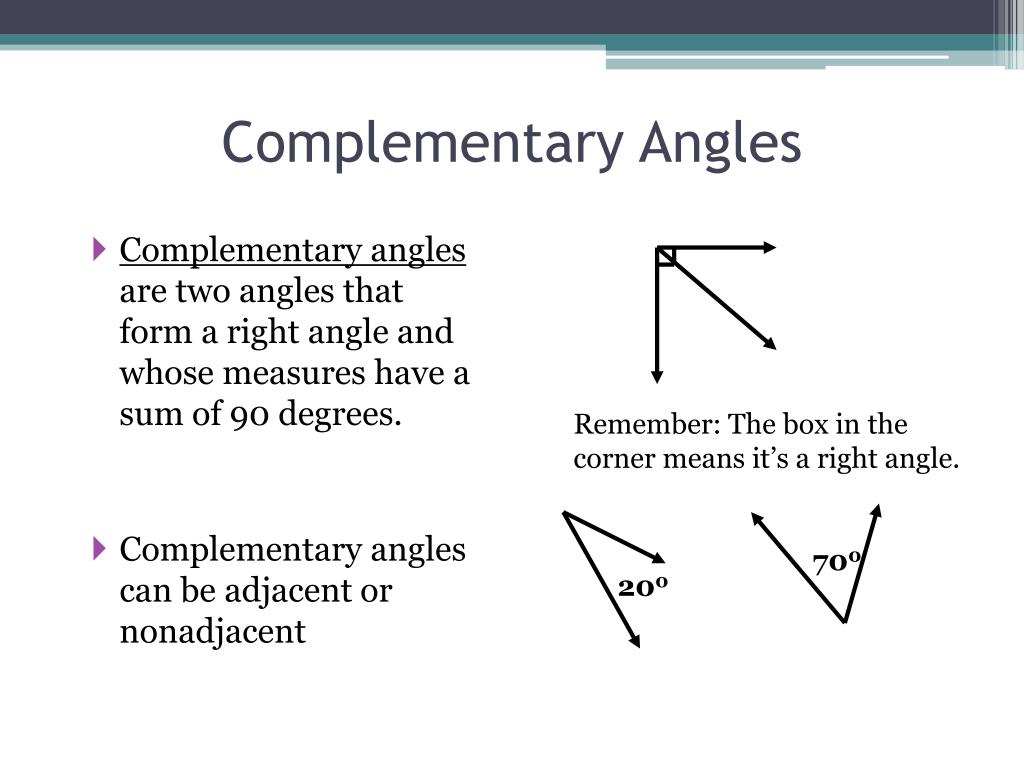
Complementary angles are those whose sum of the measures is equal to 90 degrees. You can determine the complement of a given angle by subtracting it from 90°. That would be a right angle:
Below Are Some Pairs Of Complementary Angles.
Complementary angles are angle pairs that add up to exactly 90o. Complementary angles add up to 90 degrees. Ðtuq and ðsur ðruq, ðrus and ðtuq, ðsut 60!
Can Be Used As Content For Research And Analysis.
Write the measure of the angle that is supplementary to ðafb. The following are some of the fundamental properties of supplementary angles: In euclidean geometry, the two acute angles in a right triangle are complementary, because the sum of internal angles of a triangle is 180 degrees, and the right angle itself accounts for 90 degrees.
Complementary Angles Are Formed When The Total Of Two Angles Equals 90 Degrees.
∠h and ∠i are adjacent supplementary angles while ∠h and ∠l are nonadjacent supplementary angles. Adjacent angles are angles that share one common side and one common vertex, but no common interior points (the angles don't overlap). 40 + 50 = 90 degrees.
The Measure Of Complementary Angles Adds Up To 90 Degrees.
When we join two supplementary angles, we form a straight line. Two angles are adjacent if they share a vertex and an edge with one angle on one side of the edge and the other on the other side. A linear pair must be supplementary, but a supplementary angle does not have to be.
Complementary Angles Do Not Need To Be Adjacent Angles Or Oriented In The Same Direction.
Any two angles, even something silly like a 1° 1 ° and 89° 89 °, are complementary angles meaning they add up to exactly 90° 90 °. The sum must be equal to 90 degrees too. The two unlabeled angles are separated from each other, but their sum adds to {eq}90° {/eq}.